
Are you thinking about whether or not your business needs to invest in Search Engine Optimization? If so, then you're not alone. Many businesses struggle with this question, particularly when it comes to allocating their marketing budget.
The truth is that SEO should be a key part of your overall marketing strategy. It is an essential tool for boosting customer awareness and driving traffic to your website. Consider this: organic search drives over 53% of all website traffic, making it the single largest source of trackable web traffic for most businesses.
SEO is complex, and there is a lot to consider if you want to do it properly. However, the effort is worth it, especially if you want to stand out from your competitors and make your brand more visible online.
Keep reading to learn more about SEO and how it can benefit your business!
SEO is not "one size fits all"
One of the common misconceptions about SEO is that it's a "one size fits all" solution. This simply isn't true. Different businesses have different needs. Your approach will vary depending on factors such as how long you have been in business, your industry, your target market, and your marketing goals and budget.
For example, a local business will need a different strategy than a national or international business. If you serve customers in a specific area, local SEO (optimizing for "near me" searches, Google Business Profile, and local directories) can deliver results faster than broader strategies, sometimes within weeks. Similarly, a business selling physical products will need to focus differently than a business that sells services.
It's important to determine your business's specific needs before you start investing your time or money here. Otherwise, you could end up wasting a lot of effort on strategies that don't work for your business.
Let's discuss some questions you'll need to be able to answer about your business before you attempt to take on an SEO strategy.
How do people usually find out about your business?
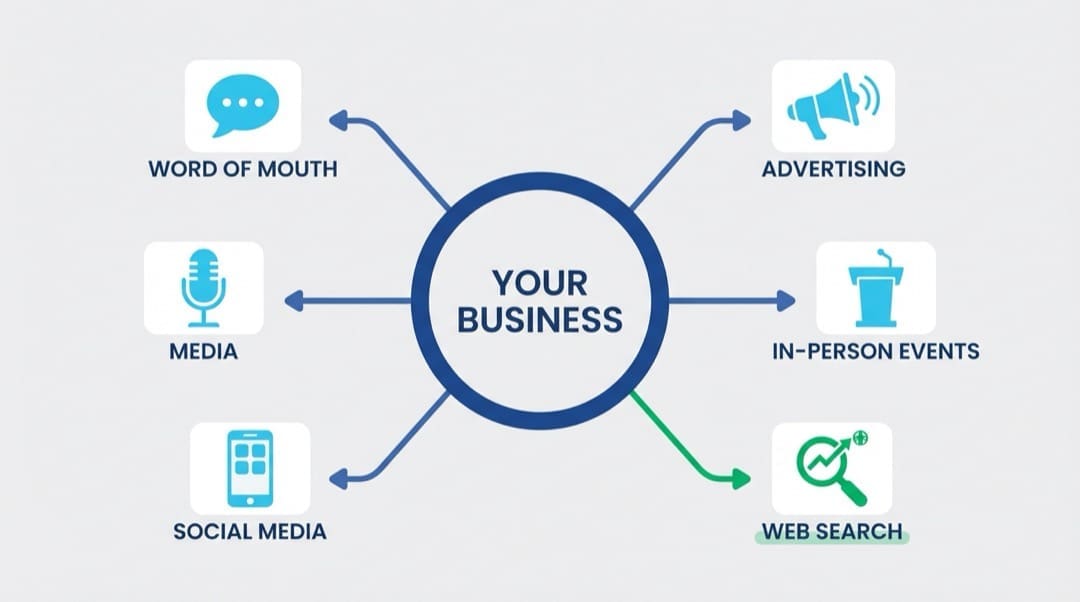
There are many ways that people can find out about your business, and here are some of the most common:
- Word of mouth: They hear about you from a friend or one of your clients
- Advertising: They read about you in an online or print ad
- Media: You appear as a guest speaker on a podcast or show, or your content is published in a journal or as a guest blog
- In-person events: You do a workshop or speak at an event in front of your ideal clients
- Social Media: You publish bits of information in hopes that people will gain enough interest in you over time to want to learn more about your offerings
- Web Search: Someone is intentionally looking for you or something you offer and your name or services come up in a list
Here you can see that the nature of your business, in combination with your marketing efforts will have a direct impact on how people find you online. How much they already know about you will also affect their intentions and actions when they do find you.
If they have already learned a lot about you from other sources, they may be ready to buy once they land on your website. However, if they simply clicked a link because they were curious (e.g., you wrote an enticing tagline), they will need some more nurturing before they build up enough KLT (Know, Like and Trust) to actually reach out or make a purchase.
Ideally, those who find you will actually have a need or desire for what you have to offer. After all, if you're going to put in the hard work to get people to visit your website, you want to make sure you're targeting the right audience, right?
Here's what to know if you are considering SEO as a means for marketing your services and increasing relevant traffic to your website.
Do: Use SEO to focus on strengthening your brand and product awareness
One of the main benefits of search engine optimization is that it can help to boost brand awareness and increase the visibility of your products or services. Even if you're not yet implementing SEO tactics, your competitors likely are. This means that they will be the ones appearing in search results, while your business is nowhere to be found.
This can have a significant impact on your visibility and sales, as potential customers are more likely to purchase from businesses that they are familiar with. By appearing in search results, you can get your brand in front of more people, build trust, and ultimately boost sales.
SEO can also help you to strengthen your brand identity by ensuring that your website appears consistently in search results related to your offerings. This can help to create a strong association between your brand and the products or services that you offer, making it more likely that people will remember your business when they need your products or services.
One of the ways this is achieved is by optimizing your website's structure and improving the quality of your content. You'll want to be very intentional about the pages and posts on your website so people searching for your service, course or coaching expertise will be able to find a landing page or article that explains the offer in a manner that is easy to read and provides value.
Don't: Use SEO to generate initial awareness
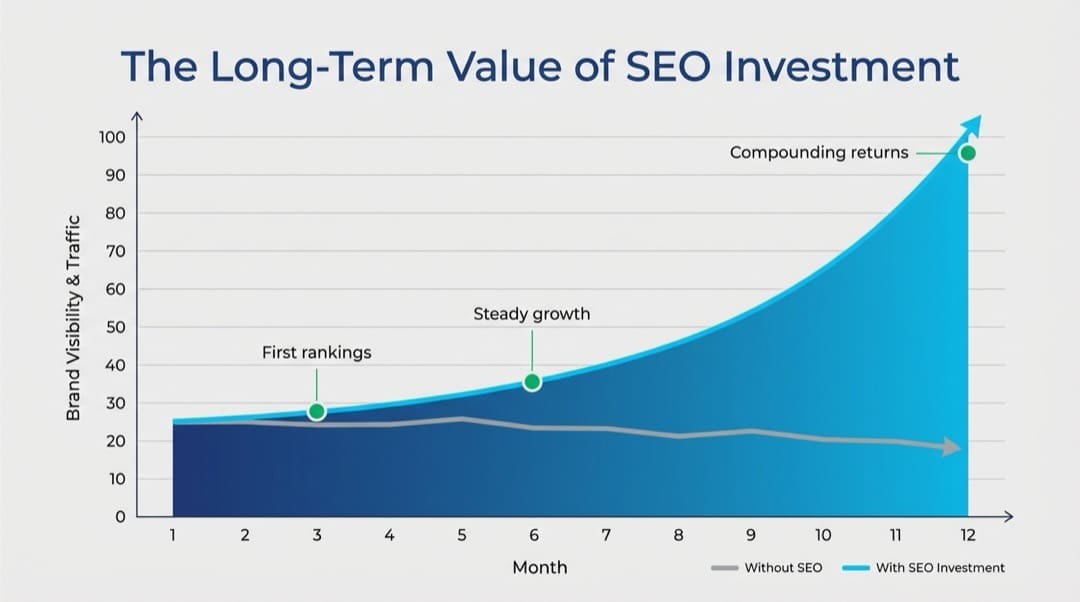
While it's true that SEO can help to increase brand awareness, it's not the most effective strategy for generating initial awareness. SEO works best when it builds on existing momentum. It can take months to see results, so it's not the best approach for quick wins.
If you're looking for immediate results, or your business is still new and doesn't have much of a customer base, social media marketing and paid advertising are better options for building that initial awareness. Focus your early marketing budget there, then layer in SEO once you have some traction.
That said, there is an important difference between these two approaches.
Paid advertising delivers immediate visibility, but stops working the moment you stop paying.
SEO takes longer to build, but generates ongoing organic traffic without per-click costs.
Organic search leads also tend to convert at higher rates than paid channels, because people trust organic results more than advertisements. The best approach for most small businesses is to use paid ads for immediate traction (driving them to specific context-relevant landing pages) while building SEO for sustainable, long-term growth.
Promote your valuable content and services
One of the best ways to implement SEO, and possibly the most doable, is to promote great content. Creating high-quality, informative, and engaging content is a great way to attract attention to your website and show your readers that you are an authority on the topics you write about.
When you create great content, people are more likely to consume and share it, which can help to increase your website's reach. Part of creating great content is making sure every element on the page works hard for you, including your images. Optimizing image metadata like alt text, titles, and captions is one of the simplest on-page SEO wins most business owners overlook.
In addition, search engines are more likely to rank great content higher in search results. So, if you want to use SEO to attract more visitors to your website, then make sure you're creating high-quality content that people will want to read and share.
SEO results don't happen overnight
I must reiterate here that it is important to understand that SEO is a long-term strategy that needs to be revisited from time to time. As mentioned above, optimizing your content for search engines is not an exact science and what works for others may not work the same way for you. Analyzing the results of your efforts regularly is an integral part of your SEO strategy.
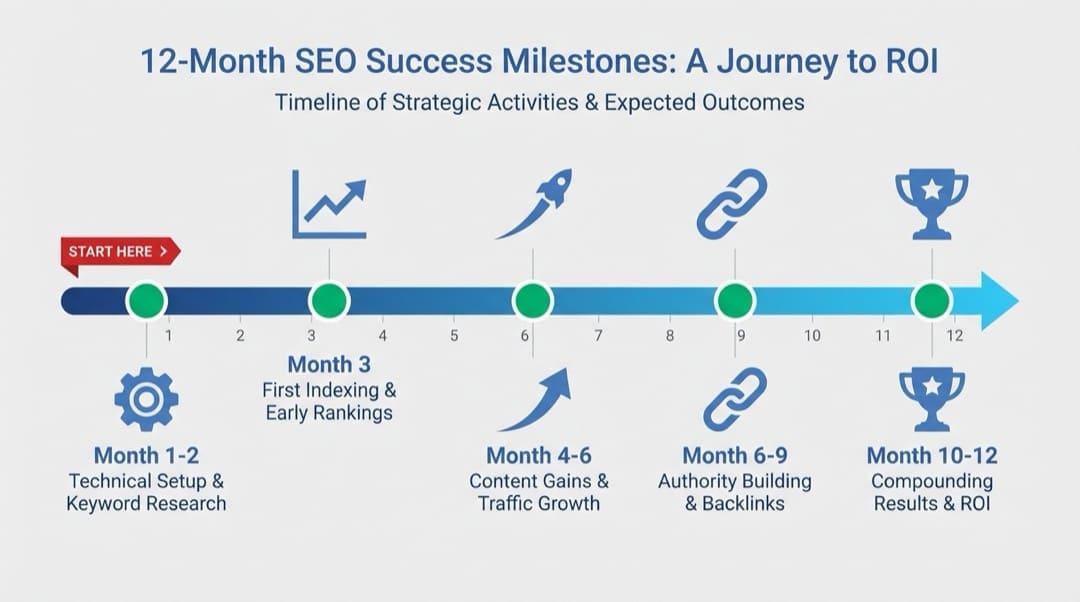
Here is a realistic timeline of what to expect when you commit to an SEO strategy:
- Months 1 to 3: Technical fixes, keyword research, and foundational content improvements. You may see increased impressions in Google Search Console, but traffic growth is still building.
- Months 3 to 6: Rankings begin to stabilize, organic traffic increases, and early conversions start appearing. This is typically when business owners stop asking "is this actually working?"
- Months 6 to 12: Measurable results kick in. Competitive keywords move, content earns links, and organic traffic compounds. ROI turns positive for most businesses in this window.
- 12 months and beyond: Compounding returns, stronger domain authority, and reduced customer acquisition costs. The content you created months ago continues generating leads without additional spend.
You will find that some content is more popular than others and what you expect to rank highly might not be getting good conversion rates. In these instances, you'll need to revisit that content and decide whether it is worth revising for different keywords or phrases or if you need a new strategy for that page or post.
The good news is, if you're willing to invest the time and effort, then SEO can be a great way to improve your website's online visibility and attract more attention from potential customers.
How AI is changing search in 2026
It is also worth noting that search is evolving beyond traditional blue links. Google's AI Overviews, voice assistants, and generative search tools increasingly surface trusted organic content in AI-curated answers.
This means your business can build brand recognition even before someone clicks through to your website. According to recent research, nearly 60% of Google searches now end without a click to an external website.
The businesses that invest in strong organic content today are positioning themselves to be the sources these AI tools reference and recommend.
Does my business need a marketing budget for SEO?
If you've read this far, hopefully, you've got a general idea of whether you need to invest more of your focus on SEO within your business. If your answer is yes, then the next question is how much time and effort you are willing to put into creating great, valuable content, and learning its ins and outs.
Most small business owners simply don't have the time to learn the strategies that work and don't work in SEO. This often results in hours and hours of work creating the wrong type of content that may or may not even be accessible to search engines trying to catalog the contents of your site. (You did create a sitemap and make sure your website can be indexed properly, right?)

You You may have the writing skills to create great content, but need help in making sure it gets found in searches and the results are enticing enough to get searchers to click through to your website. (This is where on-page SEO fundamentals come into play.)
The bottom line is that SEO should be a key part of your overall marketing strategy and if you want to get the best of it, you will likely need the guidance of an experienced SEO. The budget you'll need to allocate will depend on the amount of and type of help you need, but you will need to allocate a portion of your marketing budget to SEO.
Hiring an SEO Specialist
If you're not sure how to get started with SEO or you don't have the time to invest in it, then you might want to consider hiring an SEO specialist. An SEO specialist can help you to understand your business's specific needs and create a customized SEO strategy that will help you to achieve your goals.
They can also help you to implement and track your SEO progress over time. If you're interested in hiring an SEO specialist, make sure you talk to them first to understand what's included in their services, what the deliverables are and what their fees are before you make your decision.
The strategy your specialist implements can be as simple as a targeted content strategy.
Understanding how your competitors rank and where they are vulnerable is often one of the first things a specialist will look at.
If you have a strong budget and aggressive goals, you may opt for more a complex plan with a combination of content creation along with strategic campaigns designed to get your content published on a variety of high-authority sites.
Establishing backlinks to your websites to show Google and other search engines that they should trust and recommend you to their valued searchers is another one of the many tactics available to you when you bring on a specialist to improve your website's SEO.
The bottom line on investing in SEO for your business
SEO is always evolving, but it remains one of the most effective tools for growing your online visibility. If you're not applying the right techniques and strategies for your business, you're leaving opportunities on the table.
Investing in SEO can help you reach new customers, strengthen brand awareness, and get your products or services in front of the people who need them most. A consistent approach builds momentum that compounds over time, turning your website into a reliable source of qualified leads and organic traffic.
The question isn't whether SEO is worth it. It's whether you can afford to let your competitors own the search results while your business stays invisible.
About Investing in SEO: Quick Q & A
How much should a small business spend on SEO?
SEO budgets vary widely depending on your goals, industry, and competition. A small business can start by investing time in learning the basics and optimizing existing content. If you hire a specialist, expect to invest anywhere from a few hundred to a few thousand dollars per month depending on the scope of work. The key is to start with a clear strategy and scale up as you see results.
How long does it take to see results from SEO?
Most businesses start seeing measurable improvements within 3 to 6 months of consistent effort. However, significant results like ranking on the first page for competitive keywords can take 6 to 12 months or longer. SEO is a long-term investment that compounds over time. The sooner you start, the sooner you'll see returns.
Can I do SEO myself, or do I need to hire someone?
You can absolutely start with DIY SEO, especially for on-page basics like optimizing titles, meta descriptions, headings, and content. Many small business owners successfully handle their own SEO with the right guidance and tools. However, if you need faster results or lack the time, hiring a specialist can accelerate your progress significantly.
What's the difference between SEO and paid advertising?
Paid advertising (like Google Ads) delivers immediate visibility but stops working the moment you stop paying. SEO takes longer to build but generates ongoing organic traffic without per-click costs. The best approach for most businesses is a combination: use paid ads for immediate results while building SEO for sustainable, long-term growth.
Is SEO worth it for a business that relies on referrals?
Yes. Even referral-based businesses benefit from SEO because referred prospects will almost certainly search for you online before reaching out. A strong search presence reinforces the trust your referral source established and gives potential clients confidence in your expertise. SEO ensures that when someone looks you up, they find professional, authoritative content.
We can help with your SEO efforts

Resources
We have a few great resources to help you get started or to level up your own SEO! Click the links below to see what steps you can take to improve your chances of getting found in search engine results pages:
Explore our Website Care Plans for ongoing SEO, security, and maintenance
Subscribe to our Newsletter: Get tips and tricks for making your website a client generating machine
Take our free DIY On-page SEO course
Try the Notion SEO Command Center: A strategy dashboard for managing your entire SEO workflow
Inquire about getting an SEO strategy
Get an SEO Audit for your sales page
💡 Want a partner to handle your SEO? Our Website Care Plans include ongoing SEO optimization, content updates, security monitoring, and dedicated support so you can focus on running your business while your search presence grows steadily.



0 Comments