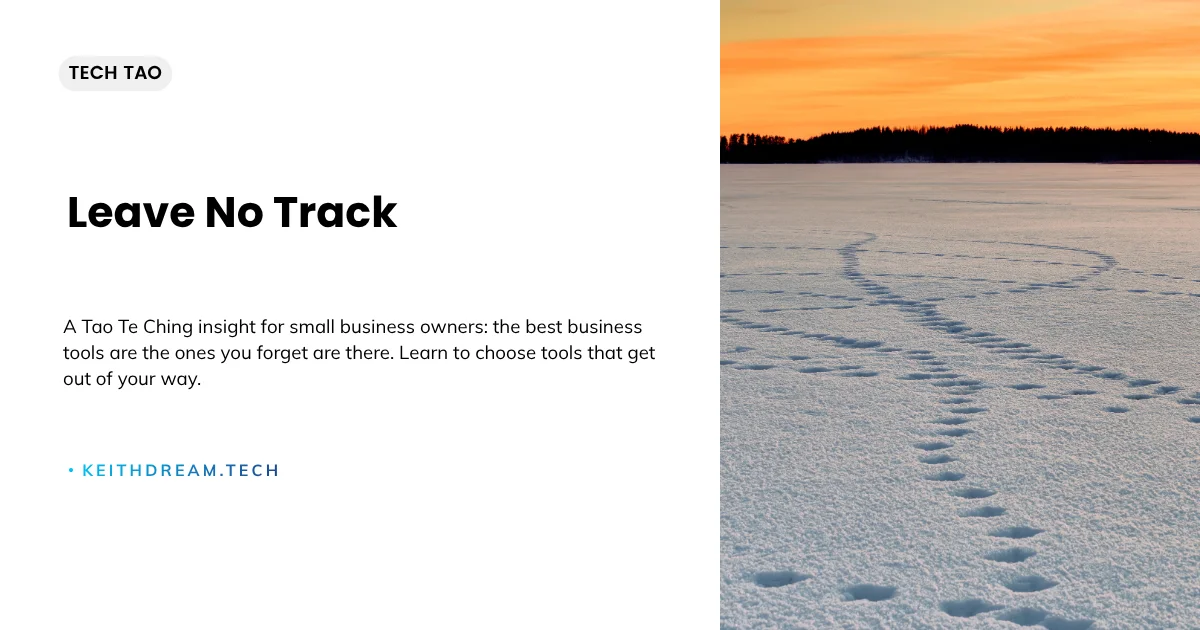
"A good traveler leaves no track. A good speaker leaves no flaws. A good reckoner needs no counting rod."
- Laozi, Tao Te Ching (Chapter 27)

In Tai Chi, there is a quality sometimes described as song (鬆), a relaxed readiness in which no energy is wasted on unnecessary tension. A master practitioner does not grip harder or move faster to gain control. They release what does not serve the movement. The result is action so economical it looks effortless.
sōng (鬆): relaxed, releasing unnecessary tension
There is a certain kind of expert you have probably met. They work quietly. They deliver. And when they are done, the process looks almost effortless. No drama. No residue. Just results.
Chapter 27 of the Tao Te Ching describes this quality in a single image: a good traveler leaves no tracks.
What does this have to do with your business tools? Everything.
This post is a guide to recognizing and choosing business tools that get out of your way so you can focus on the work that actually matters.
In this guide, you'll learn:
- The three signs a tool is working against you
- How to evaluate new tools before committing
- The minimal footprint principle for your business tech stack
- Why the right tool is often the one you forget is there
Business tools that get out of your way are present enough to do the job and invisible enough that you forget they are there. No friction when you open them. No residue when you close them. Just the work, moving forward.
The Tools That Leave Tracks
Think about the last piece of software you stopped using. Not because it was bad at its job, but because it made you feel like you were working for it rather than with it. It needed constant attention. Every time you sat down to do your real work, the tool was somehow in the way.
That is a tool that leaves tracks.
Maybe it required a steep learning curve before delivering any value. Maybe the interface was cluttered with features you never used. Maybe it sent constant notifications asking you to upgrade or connect yet another integration. Maybe the data lived in a proprietary format that made leaving complicated.
These are tools built for the tool's benefit, not yours.
Ask yourself: Is there a tool in my current stack I work around more often than I work with?
The Invisible Tool
The best software you have ever used probably had one thing in common: you forgot it was there.
When a tool is truly well-fitted to a task, it creates no friction. You think about the work, not the tool. You open it, you do the thing, you close it. Or maybe it’s open all day but you navigate seamlessly through it. No fuss. No cognitive residue that lingers into your next task.
This is what the Tao calls wu wei: effortless action, accomplishment without strain. The tool flows with your work rather than against it.
Working with coaches, consultants, and small business owners across a range of industries, one pattern shows up again and again: the most productive, least-stressed clients are not the ones with the most sophisticated tools. They are the ones whose tools have virtually disappeared into their workflow. The business owners who tend to thrive have fewer tools, better chosen, and barely remember selecting them.
I have seen this in client work. One business had been on Wix for years when the time came to consider a move, and they discovered there was no way to export their content. The platform had quietly built a wall. Another client was on Mailchimp. Not by design, just by inertia. When they moved to MailerLite, the tool stopped requiring their attention. They went from dreading the newsletter to sending it. A third eventually outgrew MailerLite and moved to ActiveCampaign. Not because simpler was wrong. Because the work had grown into something that needed more. The right tool fits the weight you are actually carrying. When it does, you forget it is there.
Ask yourself: Which tool in my stack have I stopped noticing, because it simply disappears into the work?
Three Signs Your Tool Leaves Too Many Tracks
How do you know when a business tool is working against you?
You spend more time managing the tool than using it. If configuring, troubleshooting, or updating consistently takes more time than the actual work it supports, something is off. Good tools handle their own maintenance gracefully.
You remember the tool before the task. When you think "I need to do my CRM work" instead of "I need to follow up with my leads," the tool has inserted itself into your mental model in an unhealthy way. The task should come first; the tool should be a near-invisible means of doing it.
Leaving would be a project. If switching tools means a migration headache or genuine uncertainty about losing data, that tool has left very deep tracks indeed. The ideal tool holds your data in formats you can access anytime.
Ask yourself: Which of these three signs am I recognizing right now?
Choosing Tools That Travel Lightly
When evaluating a new business tool, ask a few questions that go beyond the feature list.
What does onboarding look like? A tool that gets out of your way tends to do so from the start. If the free trial requires a 45-minute setup walkthrough before you can do anything useful, that is information about how the ongoing relationship will feel.
What does offboarding look like? Almost no one asks this before committing. Can you export everything cleanly? Tools designed with your best interests in mind make it easy to leave. They know that keeping you should be earned, not engineered through lock-in.
Does this tool fit how you already work, or does it ask you to restructure how you think? The best tool is the one that fits around your existing process, not the one that requires you to learn a new philosophy just to send an invoice.
Before choosing any tool, it helps to know what sits at the center of your work. A hub-centered approach to your business tech stack changes the way every other tool decision feels.
Ask yourself: When did I last evaluate what leaving a tool would actually require?
By the way: This same principle applies to your website. If visitors feel like they are working to use your site rather than being guided through it, your website is leaving too many tracks. Keith Dream helps small business owners build websites that get out of the way and let the work speak for itself. See website services.
The Minimal Footprint Principle
Favor the tool that does its job and occupies as little space as possible in your attention, your budget, and your digital ecosystem.
This is not about being cheap. Every tool you add is a surface area that needs maintenance, a subscription that needs paying, an integration that can break, and a cognitive overhead that accumulates. The goal is a collection of tools so well-chosen that you almost never think about them.
The sage in Chapter 27 is not a minimalist for its own sake. They are a minimalist because mastery shows in results, not complexity. A good reckoner needs no counting rod, because the counting rod would only slow them down.
Your business tools should work the same way: present enough to get the job done, invisible enough that you can focus on what actually matters.

Ask yourself: If I were building my tech stack from scratch today, what would actually make the cut?
Enjoying this series? The Tech Tao newsletter delivers practical insights at the intersection of ancient wisdom and modern business technology. Subscribe to get new posts delivered to your inbox.
Before You Leave No Track (FAQs)
Q: Does this mean I should always choose the simplest tool?
Simplicity is a feature, not a hard requirement. The right tool for a complex workflow may itself be sophisticated. The key question is not how simple the tool is, but how little friction it introduces once you have learned it.
Q: How do I know when a tool I already use has become a problem?
Pay attention to how you feel when you open it. If there is a low-level dread before you even start working, that feeling is costing you more than the subscription fee. Tools should feel neutral to positive.
Q: What if I am already locked into a tool that leaves too many tracks?
Start by auditing what it would actually take to leave. Sometimes the migration cost is lower than you expect, and knowing that changes how you feel about the current situation. Knowing your options puts you back in control.
Q: Is there a type of tool that tends to leave fewer tracks?
Tools built by small, focused teams with a clear philosophy tend to age better than platforms that have grown by acquisition. Look for tools with clear opinions about what they do and what they deliberately do not do.
Q: What if I have already committed to a tool and switching feels too disruptive?
That resistance is worth examining. Sometimes the timing genuinely matters. But often the disruption is mostly imagined, and the ongoing cost of staying is already higher than the one-time cost of leaving. Start by finding out what leaving would actually require. That alone tends to clarify things.
Q: Is a minimal tech stack right for every business?
Not necessarily. Some businesses genuinely need complex tools. The principle is not fewer tools for its own sake. It is every tool earning its place. A sophisticated stack that runs without friction is still aligned with this idea. A simple stack that constantly demands your attention is not.
This is part of the Tech Tao series, where we explore how ancient wisdom from the Tao Te Ching applies to modern business technology. Because sometimes the oldest ideas are the most innovative.
Want more posts like this? Subscribe to the Keith Dream newsletter and get the Tech Tao series delivered to your inbox.





0 Comments