"The Tao that can be told is not the eternal Tao."
- Lao Tzu, Tao Te Ching, Chapter 1
In Tai Chi and qigong practice, there is no separation between the different elements of training. The breath connects to the stance. The stance connects to the movement. The movement connects to the intention. Remove any one piece, and the form collapses.
Running a business website works the same way.
Most coaches, consultants, and educators approach their website as a series of isolated problems: the design looks outdated, the SEO isn't working, the content isn't converting, the tools are overwhelming. They fix one thing, then another, then another. But the problems keep returning because no single fix addresses the whole.
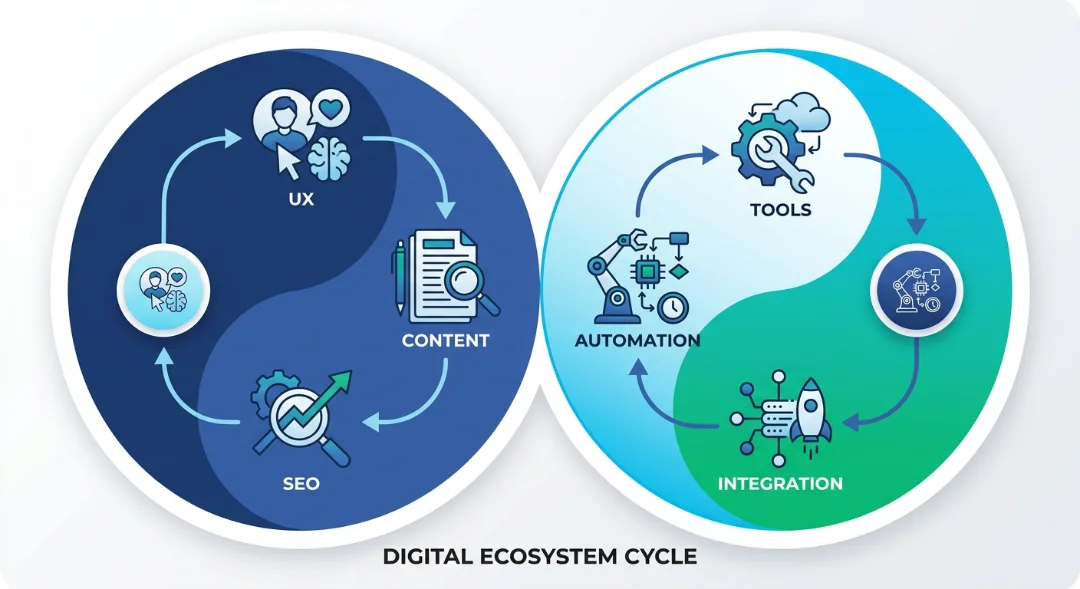
A true small business website strategy builds a connected approach to how your website looks, performs, finds new visitors, nurtures trust, and supports your offers, all as part of one coherent system rather than a collection of separate tasks.
In this Tech Tao guide, you'll learn:
- Why your business website is a living system, not a finished product
- How to design for effortless user experience
- When to patch your site and when to start fresh
- How to simplify your tech stack so your tools serve you
- How to build content that reaches the right people at the right time
- How to build a patient, long-term SEO strategy
- How to balance automation with authentic human connection
Your Website Is a Living System
The Tao Te Ching teaches that life is not static. Things flow, transform, and change. A website is no different. It is not a finished product you launch and forget. It is a living system that needs alignment, maintenance, attention, and evolution.
What this means practically:
- Your messaging will evolve as your ideal client profile becomes clearer
- Your design will need to adapt as technology and user expectations shift
- Your content will need to grow and deepen as your expertise develops
- Your tools will need to be assessed and simplified as your business matures
Understanding this changes how you relate to your website. Instead of asking "Is it done?" you ask: "Is it in balance? Is it serving me well right now? What needs attention?"

Effortless UX - Design That Gets Out of the Way
The Taoist concept of wu wei, often translated as effortless action, applies directly to website user experience. A well-designed website does not make visitors work. It guides them naturally from curiosity to action, like water finding the path of least resistance.
What this looks like in practice:
- Clear navigation that answers "where do I go next?" without friction
- Fast page load speeds that never interrupt the browsing experience
- Mobile experience that feels native, not squeezed
- A clear path from every page toward a meaningful next step
When visitors have to think, hunt, or figure things out, they leave. When your site feels intuitive and clear, they stay, explore, and trust.
For a deeper guide to friction-free website design and how wu wei applies to your site: Tech Tao: Wu Wei and Your Website - The Art of Effortless User Experience
When to Refresh and When to Rebuild
One of the most common and costly mistakes in website strategy is patching a broken foundation. Like the Zen story of the scholar who must empty his cup before new wisdom can enter, there are moments when the right path forward is to start fresh.
Refresh when:
- Your messaging and audience are still accurate
- The core structure is sound
- You need targeted improvements to speed, content, or mobile experience
Rebuild when:
- Your business has evolved and the site no longer reflects who you serve
- Technical debt has accumulated to the point where updates create new problems
- You are embarrassed to send people to your site
- SEO cannot be properly implemented because the structure was never designed for it
A strategic website migration, planned thoughtfully with proper redirects and content audits, protects the SEO value you have already earned while giving you a clean, current foundation.
For a full guide to this decision: Tech Tao: Empty Your Cup - Why Starting Fresh Sometimes Beats Patching the Old
☝️ Coming soon - Subscribe to the Keith Dream newsletter to catch this one when it lands.
Your Tech Stack - Use Less, Do More
The Tao Te Ching says: "To attain knowledge, add things every day. To attain wisdom, remove things every day."
This principle applies perfectly to the tools, plugins, and platforms most small business websites accumulate. Every tool added to your stack is a new thing to learn, maintain, update, and pay for. And often, the tools overlap, creating redundancy and confusion rather than clarity.
The simplest tech stack that does the job is the best tech stack. Ask of every tool:
- Am I using this regularly?
- Does it solve a problem I actually have?
- Is there something already in my stack that does this?
- What would happen if I removed it?
The goal is not to use the most tools, but to use the fewest tools that let you do your most important work.
For a Taoist reflection on simplifying your business tools: Tech Tao: The Best Tool Is the One You Don't Need
☝️ Coming soon - Subscribe to the Keith Dream newsletter to catch this one when it lands.
Want calm, practical website strategy notes in your inbox? Subscribe to the Keith Dream newsletter for small business website guidance.
Content Strategy - Flow to Your Ideal Client
Water does not force its way through obstacles. It flows around them, through them, finding the path of least resistance. And over time, it even shapes stone.
Your content strategy should work the same way. Content that pushes, pressures, and pitches creates resistance. Content that flows meets people where they are, answers the questions they are already asking, and gently guides them toward the help they need.
A useful content strategy maps your content to the natural stages of your ideal client's decision-making process:
- Awareness: They know something is wrong but aren't sure what to do. Create blog posts and social content that name their problem clearly.
- Consideration: They're researching options. Deliver guides, comparisons, and case studies that position you as the knowledgeable guide.
- Decision: They've decided to get help and are choosing who. Lead them to your about page, services, testimonials, and portfolio.
Consistent, valuable content at each stage builds trust naturally and compounds over time. Unlike paid advertising, a blog post you write today can generate leads for years.
For the full guide to Taoist content strategy for the buyer journey: Tech Tao: Be Water, My Friend - Building Content That Flows to Your Ideal Client
☝️ Coming soon - Subscribe to the Keith Dream newsletter to catch this one when it lands.
Patient SEO - The Long Game Is the Only Game
Lao Tzu wrote: "Nature does not hurry, yet everything is accomplished."
SEO works the same way. The coaches, consultants, and educators who build sustainable organic traffic all share one thing in common: they committed to the long game before they saw results.
The fundamentals compound:
- Useful, well-structured content earns authority over time
- Internal links strengthen how search engines understand your site
- A consistent publishing cadence signals that your site is active and relevant
- Technical foundations, such as fast page loading, clean URLs, and proper heading structure, build trust
None of this is exciting. All of it works. And unlike quick hacks, the results are durable.
For a deeper reflection on building a patient, sustainable SEO strategy: Tech Tao: The Tao of SEO - Patient Strategy Beats Quick Hacks
☝️ Coming soon - Subscribe to the Keith Dream newsletter to catch this one when it lands.
Automation - Balance the Machine with the Human
The yin and yang of a healthy business website: some processes belong to the machine, and some belong to you.
Automate the repetitive, predictable, and time-draining tasks: scheduling, invoice reminders, welcome email sequences, appointment confirmations, and backup systems.
Stay human for the moments that build trust: the sales conversation, the personal check-in with a long-term client, the response to a difficult situation, and the creative decisions that carry your voice.
The risk of over-automating is real. When systems replace the human moments in a relationship-based business, clients notice. Your website and the systems behind it should amplify your human presence, not substitute for it.
For a full guide to the yin and yang of business automation: Tech Tao: Yin and Yang of Automation - When to Automate and When to Stay Human
☝️ Coming soon - Subscribe to the Keith Dream newsletter to catch this one when it lands.
The Practice of Tending Your Website
A business website is not a project with a finish line. It is a practice. Like Tai Chi practice, it benefits from regular, patient attention rather than occasional bursts of effort.
The rhythm that works for most coaches, consultants, and educators:
- Weekly: Publish one piece of new content
- Monthly: Review analytics, check for broken links or outdated content
- Quarterly: Review your tech stack, check in on SEO performance, assess whether your messaging still reflects your current positioning
- Annually: Consider whether a deeper refresh or rebuild is needed
When you approach your website as a living practice, you stop chasing the "done" that never arrives. You start tending something that grows.
🌊 If your website needs a strategy review, a fresh direction, or a clearer path from first visit to inquiry, a focused website strategy session can help you see what you have, what you need, and what to do next.
Before You Begin Your Practice (FAQs)
How often should I update my business website?
It depends on your industry and your offers. Generally: At a minimum, add or update content weekly and review the site for outdated information monthly. A proper strategy review is worth doing quarterly, and a decision on whether a refresh or rebuild is needed is worth making annually. The goal is not constant change but consistent, intentional attention.
What's the most important thing to get right on a business website?
Clarity. Visitors should immediately understand who you help, what you do, and what to do next. No amount of beautiful design, clever SEO, or sophisticated automation compensates for a confusing or unclear message.
Do I need a blog if I'm a coach or consultant?
Yes, if you want sustainable organic visibility. A blog with useful, well-targeted content is one of the strongest long-term investments a service-based business can make. It builds authority, drives search traffic, and gives you shareable content for social and newsletters, all from a single piece of work.
How long does it take for a business website to generate consistent leads?
For a site with a clear message, good UX, and consistent new content, most service businesses begin seeing meaningful organic leads within 6 to 12 months. The timeline depends on your niche competitiveness, publishing consistency, and the quality of what you publish.
When is it time to hire help for my website?
When the website is a clear business asset and the time you spend on it has a measurable cost, it is usually worth bringing in help. Start with strategy before execution: understand what the site needs to accomplish before hiring for design, development, or content.
Want more practical reflections on calmer, more sustainable business websites? Subscribe for website strategy and small business tech notes from Keith Dream.
This is part of the Tech Tao series, where we explore how ancient wisdom from the Tao Te Ching applies to modern business technology. Because sometimes the oldest ideas are the most innovative.



0 Comments